




Y2K Bottoms





Y2K Bottoms — From Stacked Baggy Jeans and Parachute Cargos to Jorts, Pleated Minis and Matching Joggers
The bottom half of the 2000s sat on the hip and fell over the shoe, and it carried graphics denim had never worn before: wings down the leg, rhinestones in floral vines, flames from the hem. Our Y2K bottoms collection gathers everything the decade wore below the belt — baggy, stacked and barrel jeans, parachute and cargo pants, sweatpants and tracksuit sets, jorts, cutoff shorts and pleated mini skirts — the wide-leg, low-rise silhouette of skate, rap, mall goth and McBling.
-
Rivet Jean
Regular price $120.00 USDRegular price -
Angel Wing Jeans
Regular price $120.00 USDRegular price -
Dragon Baggy Jeans
Regular price $120.00 USDRegular price -
Baggy Jeans With Rhinestones
Regular price $120.00 USDRegular price -
Jeans With Star Embroidery
Regular price $120.00 USDRegular price -
Striped Jeans
Regular price $120.00 USDRegular price -
Snake Print Jeans
Regular price $120.00 USDRegular price -
Tribal Print Jeans
Regular price $120.00 USDRegular price -
Chain Print Jeans
Regular price $120.00 USDRegular price -
Pink Jeans With Star
Regular price $120.00 USDRegular price -
Angel Jeans
Regular price $120.00 USDRegular price -
Knot Jeans
Regular price $79.00 USDRegular price -
Embroidered Camouflage Jeans
Regular price $120.00 USDRegular price -
Calligraphy Jeans
Regular price $120.00 USDRegular price -
Studded Jeans
Regular price $59.00 USDRegular price -
Blue Stacked Jeans
Regular price $120.00 USDRegular price -
Black Stacked Jeans
Regular price $120.00 USDRegular price -
White Stacked Jeans
Regular price $120.00 USDRegular price -
Printed Japanese Jeans
Regular price $120.00 USDRegular price -
Faded Baggy Jeans
Regular price $120.00 USDRegular price -
White Barrel Jeans
Regular price $120.00 USDRegular price -
Paint Splatter Jeans
Regular price $120.00 USDRegular price -
Black Barrel Jeans
Regular price $120.00 USDRegular price -
Raw Baggy Jeans
Regular price $120.00 USDRegular price


Around 2001 the waistband dropped to the hip and the leg widened to cover the shoe, and the 2000s had its silhouette: low, loose, dragging, belted in the gap. Everything that followed was a variation. Y2K Bottoms is that silhouette in seven categories and nearly ninety pieces, denim and nylon, fleece and pleats, the foundation every top in the store was cut to sit over.
Denim — Baggy, Stacked, Barrel and Decorated
The jean was the decade's canvas. Stacked at the ankle the way rap videos wore it, baggy with a raw hem the way skate wore it, barrel-curved at the thigh, and covered: angel wings sketched down the leg, rhinestone florals, full-leg rivets, a dragon coiled in red, flames from the hem, cow print, snake texture, calligraphy and drill text sprayed across the thigh. Jorts were the same jean cut off below the knee for summer, graphic and all. Cutoff shorts stopped at the thigh, frayed by hand, with a row of grommets for the pop-punk corridor.
Nylon and Fleece — Parachute Cargos, Sweatpants and Tracksuit Sets
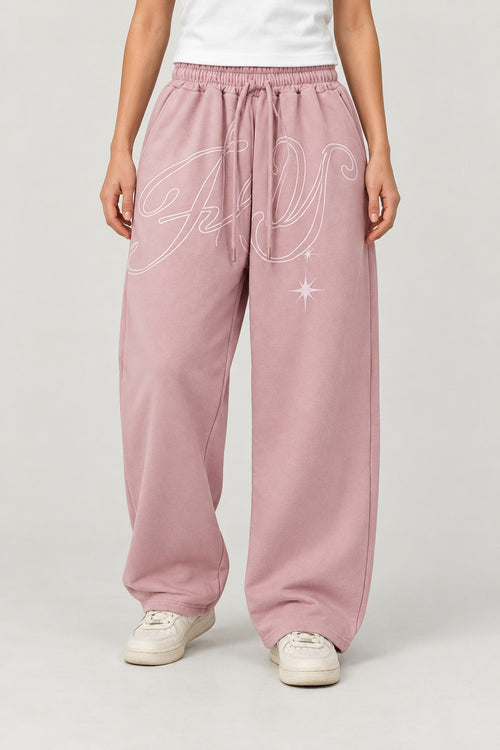
Not every wide leg was denim. Parachute pants came from rave with canopy proportions and cargo pockets, and became the cyber Y2K and techwear trouser. Leather went baggy in matte black, plaid got cut like pyjamas, bones got traced down both legs. Sweatpants left the gym for good: signed in cursive down the leg, patterned in iron crosses, striped like a track pant, and matched to a hoodie in eight full sets, camo, cherry blossom, florals, snake print, kelly green. The tracksuit was the mall uniform of 2004, worn two sizes up with a chain outside the top.
The Mini Skirt — Pleated, Low and Over Something
The pleated mini was the 2000s skirt, worn on the hip over fishnets or knee socks, with a studded belt in the gap. Riveted along the waistband it belonged to the pop-punk stage and the mall-goth corridor; gathered into ruffled tiers it belonged to the coquette and Bratz side of the same mall. Either way it was short, layered and belted, and it connected three subcultures in one garment.
How the 2000s Wore Bottoms — Low Rise, Wide Leg, Belt in the Gap
Waistband on the hip, never the waist. Leg wide enough to hide the shoe, hem on the floor or bunched at the ankle. A belt even on a drawstring pant, buckle off-center, strap tail hanging past the second loop. On top, something short, a baby tee, a crop tank, a cropped hoodie, so the denim showed from the belt down. Graphic denim took a plain top; plain denim took a graphic hoodie. The chain clipped to the belt loop, the sunglasses hooked into the waistband, the whole lower half built to be seen.
Why Y2K Bottoms Came Back — The End of Skinny and the Space It Left
For a decade the leg got tighter and the waist got higher until there was nothing left to decorate and nowhere to put a belt. The return of the low rise and the wide leg around 2021 reopened both, and the 2000s vocabulary came back with them: the stack, the cargo pocket, the parachute volume, the rhinestone vine, the pleated mini. Y2K bottoms today are the proof that the lower half of an outfit was never meant to be quiet, and the one place where the decade's maximalism had the most fabric to work with.


